Ex. 1.Write the following sentences in the most likely form (the present continuous, ‘going to’, or the future simple):
1) We’ve run out of milk. – Oh, have we? I … (go) and get some. 2) So you’ve moved into your new house. Congratulations! – Thank you. We … (have) a party soon. 3) I’m afraid I can’t come to dinner on Saturday I … (meet) Tim. 4) Josh … (be) five next Tuesdays. 5) It’s raining – we … (have to) take an umbrella. 6) My cousins … (come) to stay with us at the weekend. 7) Look at that car! It … (hit) that tree! 8) I promise I … (not do) that again. 9) Did you hear that the company … (open) a new factory? 10) You look tired. Sit down and I … (make) you a cup of tea. 11) I think there’s someone at the door. – Ok, I … (go) and answer it. 12) … (you / stay) at home this weekend? 13) Kate’s really unhappy at work so she … (look for) a new job soon. 14) She looks really upset. I think she … (cry). 15) I know you’ve got a lot to do so I (try) and help you as much as I can. 16) What … (you / do) when you’ve spent all your money? 17) Kate phoned up. She … (come round) to see us this afternoon. 18) I’m sorry I made you angry. I … (not do) that again. 19) Look at the sky. It … (be) a lovely day today. 20) I’m sorry you’re leaving. I hope you … (come back) and see us soon.
Ex. 2.Write these sentences in full, putting the verbs into the present continuous and supply the missing words where necessary.
1) I / see / them / Saturday.
2) They / come / here / three weeks.
3) I / meet / John / three o’clock.
4) What / you do / Friday night?
5) I / go / to the disco / Saturday evening.
6) We / go back / to the States / three years.
7) They / go on holiday / two days’ time.
8) I / not come home / Friday.
9) You / work late / tomorrow night?
10) We / not go to school / next week.
Ex. 3.Complete each sentence using a verb from the list in the present simple form. Then match each sentence a to j with a description 1 to 10 of where you might read or hear it.
close continue expire leave open retire rise start
take off take place
a) Mrs. Douglas … at the end of this term, and we wish her all happiness for the future.
b) There has been a change to the schedule and your flight now … at 18.40.
c) The exhibition ... until 31 December. Don’t miss it.
d) The match ... at three o’clock, so please be here by two.
e) The opening ceremony ... on 27 July.
f) Saturday 18 March. The sun ... at 6.08.
g) The licence for this software ... one year from the agreement date.
h) This offer … on 30 September so buy now to avoid disappointment!
i) The 4.30 to York … from Platform 1. Cross the footbridge at the end of this platform.
j) Doors … at 18.00.
1) Cinema door
2) Travel information desk
3) Newspaper review
4) Advertisement
5) CD-Rom leaflet
6) Notice on a sport club notice board
Ex. 4.Write these sentences, putting the verbs into the future simple or present simple.
1) I (give) it to them when they (visit) us.
2) I (not send) the parcel until I (hear) from you.
3) As soon as they (phone) me, I (contact) you.
4) I (see) you before I (fly) to Paris.
5) They (send) you the money before they (leave).
6) When I (talk) to him, I (give) him your news.
7) She (visit) her parents before she (go) to the airport.
8) I (finish) this when I (be) at the office.
9) I (send) you a postcard when I (get) to Bermuda.
10) She (do) her homework before she (go) out.
11) After I (visit) the hospital, I (go) and see her parents.
12) I (phone) Mary when we (get) to San Francisco.
13) I (call) you as soon as we (sign) the contract.
14) He (not do) anything before you (tell) him to.
15) You (be) very surprised when you (meet) him.
Ex. 5.If possible, use the present simple of an appropriate verb to complete these sentences. If the present simple is not correct, use ‘will + infinitive’.
1) Ellis’s new play … at the Grand Theatre next week. 2) With more practice she … an excellent violinist. 3) National No-Smoking week … on October 24th. 4) On tonight’s programme we … to the deputy president about the latest unemployment figures. 5) In a few moments, I … over there and give the signal to start running. 6) The eclipse … at three minutes past midday. 7) Dr Brown … available again at 9.00 tomorrow. 8) The door in front of us … automatically in a few moments. 9) We … Amsterdam on Tuesday morning, but we … Sydney until Thursday evening.
Ex. 6.Which of the verbs is correct or more appropriate? Underline one or both.
1) Tonight I’m going to check that Susan does / will do her homework correctly. 2) By the time the book is published next year, no-one will be interested in what scandalous claims it makes / will make. 3) Some people believe that the earth is destroyed / will be destroyed by a nuclear accident. 4) The new regulations mean that businesses have to / will have to complete the form by 1st April. 5) Jim just phoned. He says that he is / will be with us tonight. 6) It says in the programme that the concert finishes / will finish at 10.20.
Ex. 7.Complete the following sentences with ‘will’ or ‘shall’ and a verb from the list:
offer make tell have buy drop wash announce
receive be sentenced phone carry be invite go
1) I’m sorry about losing that book. I … you another one next week. 2) I … one of those cases for you. 3) The temperature … significantly during the afternoon. 4) … you … me when you get the news? You’ve got my number. 5) The Chancellor … the details of the budget at 10 o’clock tomorrow. 6) … we … her the truth about what happened? 7) I expect they … here soon. 8) You … your exam results by post during the first few days of August. 9) I … not … them here again, whatever you say. 10) If he is found guilty, he … to life imprisonment. 11) I … never … the same mistake again. 12) … we … for a swim this afternoon? 13) They definitely … not … me the job: I had a terrible interview. 14) … I … these plates? 15) I’m determined that he … everything he wants.
Ex. 8.Write the correct form of ‘going to’ to complete these sentences:
1) When (you) … phone her?
2) (They not) … stay very long.
3) What (you) … say to your father?
4) (I not) … pay anything.
5) (We) … play tennis tomorrow?
6) (She) … live in Mexico for a few months.
7) (The machine) … work?
8) (Your parents) … have a holiday this year?
9) (They) … borrow some money from the bank.
10) (I not) … eat there again.
Ex. 9.Write the correct form of ‘going to’ and use one of these verbs to complete the sentences. Use each verb once only.
finish complain fall off be miss die lift drive work fail
1) Look at those clouds! It … .
2) Look at the sun! It … hot today.
3) Susan’s not working very hard. I think she … her exams.
4) He’s very angry. He … to the manager.
5) It’s nearly four o’clock. The lesson … soon.
6) I don’t like travelling by plane. I … there.
7) This plan is too complicated. It (not) … .
8) The President’s very ill. I think he … .
9) Watch the baby! She … the bed !
10) This bus is very slow. I think we … the train.
Ex. 10.In your notebook, supply the ‘going to’ or the present continuous future for these sentences. If two answers are possible, write them both.
1) We … at home tonight. (stay)
2) Look at the sky. It … tomorrow. (rain)
3) We … at a restaurant tonight. (eat)
4) They … to Manchester tomorrow morning. (drive)
5) I … my teeth, have a wash, and go to bed. (brush)
6) Be careful with that plate! You … it! (break)
7) My parents … with us for the weekend. (stay)
8) Who’s … him the news? (tell)
9) Hurry up! We … the train! (miss)
10) How many people … today? (arrive)
11) They … Nick at 10 o’clock tomorrow. (see)
12) I … to the seaside next weekend. (go)
13) Who … to John’s party later? (come)
14) Bring your hat and gloves – it … cold later tonight. (get)
15) Mary … to Barbados next Tuesday. (fly)
16) Our friends … us before the concert. (meet)
17) We … into our new house next month. (move)
Ex. 11.Read these famous failed predictions. Then complete the sentence using ‘will + the verb’ in brackets.
a) We are in September 1914: according to most newspapers in Britain and Germany, the war (be) over by Christmas. They cannot imagine that the war (continue) until 1918, and (claim) the lives of about 9 million in the military and a further 7 million civilians.
b) We are in 1919: according to geologist Albert Porta, the conjunction of six planets (cause) the Sun to explode. In fact, the Sun (probably destroy) the Earth one day, when it becomes a red giant in about 4.5 billion years.
c) We are in 1977: according to Ken Olson, head of a computer company, people (never want) a computer in the home. Latest predictions (2005) suggest that computer ownership (reach) 1.3 billion machines worldwide by 2010.
d) We are in 1999: according to many scientists, computers (crash) and (cause) chaos on the first day of the new millennium.
Ex. 12.Make your predictions about the future concerning the following:
1) the climate in the next few years (get milder)
2) the ozone layer (become thinner)
3) drugs against every kind of disease (scientist – find cure for)
4) traffic in big cities (get much heavier)
5) trains and busses in the near future (offer more comfort)
6) mobile phones in a couple of years (be hand-free)
7) fast food (people / reject – become more health-conscious)
8) shops in the near future (supermarkets of new design – replace local shops)
9) computers (be able – speak language)
Ex. 13.Express a spontaneous decision, offer or promise in the response:
1) It’s getting chilly in the room. – Is it? I … (turn) on the heater. 2) Have you decided what to do about the job that was advertised? – Yes, I … (apply) for it. 3) Can I speak to Jim, please? – Just a moment. I … (put) him through. 4) I need to go to the airport tomorrow morning. – That’s no problem. I … (give) you a lift. 5) I haven’t got enough money to get home. – Don’t worry. I … (lend) you the money if you like. 6) My bicycle has a flat tyre. Can you fix it for me? – OK, but I’m busy at the moment, I … (do) it tomorrow. 7) Oh, dear. I’ve spilt my coffee. – I … (get) a cloth. 8) I have a splitting headache. – I … (get) you an aspirin. 9) The guests are coming in half an hour. – Oh, are they? Then I … (lay) the table. 10) I’m dying of thirst. – I … (go and fetch) Coca-Cola. 11) I feel awful. – I … (call) the doctor right away. 12) I want to go out tonight but I don’t have a baby-sitter. – Don’t worry. I … (look) after the kids.
Ex. 14.Write these sentences, putting the verbs into the Future Simple.
1) I’m sure he (not be) late.
2) I (open) the window for you?
3) How long the journey (take)?
4) I suppose she (be) in London next week.
5) John (phone) your office for you.
6) There (be) a lot of people at the meeting?
7) What time the race (start)?
8) He (never agree) to your idea.
9) You (never see) your money again.
10) What’s the matter? I (phone) the doctor?
11) Don’t worry. I (pay) for the damage to your car.
12) You (be) at home tomorrow?
13) The company (not give) you an extra day’s holiday.
14) Don’t touch that! You (hurt) yourself!
15) There (not be) any newspapers tomorrow.
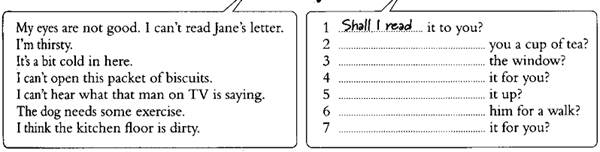
Ex. 15.Your grandmother has a few problems. Offer her your help:
Ex. 16.Identify the meaning of the future simple in each sentence on the left and match it with the appropriate definition on the right:
1) The world will become overpopulated in 50 years.
a) an action regarded by the speaker as probable to happen
2) Christmas will fall on Saturday this year.
b) a prediction based on analysis
3) I am sure you will enjoy your visit to the Zoo.
c) a spontaneous decision
4) My father is approaching his retirement age, so he will probably move to the country.
d) a request addressed to the 2nd person
5) I’ll go and sort out some drinks for the guests.
e) a promise
6) You can tell me your secret. I won’t tell anyone else.
f) reluctance to do something
7) Will you call me back later?
g) a warning
8) What time shall we start off tomorrow?
h) determination strengthened at the time of speaking
9) Be careful! If you tease the cat, he will scratch you!
i) asking for advice
10) I’ve told her so many times to tidy her room, but she won’t do it.
j) an enquiry for an instruction
11) Shall I give you another day or two for the essay?
k) a fact about the future which is out of anybody’s control
12) What shall I say if she calls?
l) an offer
13) ‘I’ll be a pilot when I grow up’, said the little boy.
m) a prediction based on a person’s belief
Ex. 17.Comment on the use of the future simple in the following sentences:
1) I’ll come round tomorrow night. 2) His father won’t hear of his giving up the job. 3) Some day, perhaps, I shall come to life again. 4) John is not here. He’ll come back soon though. 5) I’ll drop you a note when I have seen Paula. 6) You’ll break something if you keep moving around. 7) I don’t know what I’ll do when I leave here. I’ll probably never get another job. 8) Will you forgive me for saying that? 9) Shall I turn on the lights for you? 10) It’ll be easier when you get away. We won’t see one another every day. 11) Don’t bother about me. I’ll look at the town myself. 12) He’s got a lovely voice. He’ll go a long way. You’ll see. 13) The sun will dry we quite soon. 14) They will do whatever they have to do to regain their self-respect. 15) They’ll wonder where I am. 16) Andy is overtired, and unless he rests he will have a breakdown. 17) It won’t do Tone any real harm to wait. 18) I’ll only go to oblige you. 19) Most people will assume that I intend to drift around and become completely idle. 20) I shall go through with it. I won’t let Renny down. 21) A boat will be set to fetch them. 22) Won’t you sit down? 23) I am forced to discharge you from service. The necessary papers will reach you in due course. Meanwhile you will return to your post. 23) Now go to bed, or you’ll get ill. 24) The dining-room will be painted next. 25) I think he’ll speak to us about it. 26) You shall have it back tomorrow. 27) This barn will be pulled down soon. 28) He’ll certainly find it out for you.
Ex. 18.Write the verbs below as the future continuous or the future simple:
1) I … (see) them tomorrow – I … (tell) them what you said. 2) … (you work) all tomorrow evening? 3) She … (stay) in Leeds all weekend. 4) She … (visit) our office next week – I … (ask) her then. 5) I … (see) the sales manager at the marketing meeting on Monday and I’m sure she … (give) me the figures then. 6) I … (not be able) to lend you the car – I … (use) it all night. 7) Next year they … (live) in Spain. 8) This time next week we … (sit) on the beach. 9) The children … (stay) with their grandparents for the summer holidays. 10) At four o’clock on Tuesday afternoon we … (fly) over Paris. 11) What … (you do) early on Monday night? 12) They … (come) round for dinner tomorrow evening – I … (show) them photographs then. 13) He … (arrive) in Paris now. 14) We … (not hear) from him for some time – he … (be) in Panama. 15) Don’t phone them now: they … (have) dinner.