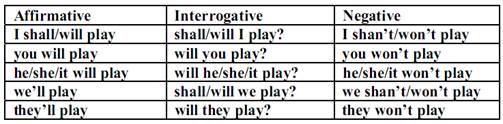
Formation. It is an analytical form which is built up by means of the auxiliary verbs shall/will and the infinitive stem of the notional verb.
Main Uses
The Future Simple is used to denote:
− a single action completed in the future: I shan’t stay with them. It will be cold in the evening.
− habitual, repeated actions in the future: Next year we’ll meet each other more often. So I’ll see you often in winter?
− a succession of actions in the future: He’ll ring you up and tell you everything. I’ll wait in the next room and come back when she’s gone.
− permanent future actions generally characterizing the person denoted by the subject of the sentence: I’m afraid he’ll be a bit lonely, poor darling.
– prediction about the future: Tonight’s programme will be very interesting.
− an action decided on spontaneously, out of circumstances: I’m too tired to walk home. I’ll take a taxi.
The Future Simple in such cases often has the meaning of a promise, an offer, a warning.
I won’t tell anybody, I promise. I’ll pick you up to the airport. I shall punish you.
– formal announcements of future plans: The new President will move into the White House tomorrow.
– weather forecasts: Rain will continue throughout the day.
– hopes, expectations, thoughts about the future. Used after the verbs like assume, believe, doubt, expect, hope, reckon, suppose, think, be sure, be afraid and with adverbs like perhaps, probably, possibly, definitely: I expect, you’ll be here soon. Do you think she’ll bring her boyfriend?
− an enquiry for an instruction, recommendation or advice in interrogative sentences: Shall we do it right now? Shall I help you?
− refusals, resistance or reluctance to do something, typical behavior: The door won’t open. I’m always asking him to come but he won’t. She will always argue to prove her point of view.
– willingness to do or not to do something in the future: I promise I'll be there. I’ll never speak to him again.
a) promise: I’ll do it for you.
b) request: Will you open the window?
c) offer: I’ll look after the children for you.
d) refusal: I won’t go with you.
e) agreement: Yes, I will go with you.
f) determination: I’ll certainly tell the truth.
g) threat: Stop it. I’ll call the police.
The use of shall
In spoken English, shall is most often used in the questions with Ior we to make offers or suggestions, advice instructions: Shall I come with you? What shall we do tomorrow?
Shall is occasionally used to express strong determination about oneself or someone else: I shall go away. I don’t care what you think.
Be Going to – The Present Simple – The Present Continuous –
The Future Simple
Be going to
The Present Simple
The Present Continuous
The Future Simple
always indicates a link with the present
1. is used to make predictions based on the present evidence: There are a lot of clouds in the sky. It is going to rain.
2. is used to talk about one’s intensions: I’m going to have a rest in the evening.
1. official plans, schedules and itineraries: The train leaves Plymouth at 11.30 and arrives in London at 14.45.
2. in subordinate clauses of time and concession: If I have time, I’ll visit you tomorrow.
1. is used to talk about personal plans for the future: We’re having a housewarming party tomorrow.
1. is used to make predictions based on one’s point of view: You’ll like it.
2. is used to introduce facts about the future: She will be 17 next year.
3. is used to talk about decisions made at the moment of speech: Today’s Ann’s birthday. – I’ve forgotten. I’ll phone her.
4. to express beliefs, thoughts, assumptions, doubts about the future: I’m sure you’ll enjoy the play.
Sometimes it is more appropriate to use ‘will’ rather than ‘be going to’ in
1) offers and suggestions (willingness): I’ll help you with your physics homework, if you like.
2) requests: Will you help me with my physics homework?
3) most conditional sentences: If I get a computer, we’ll be able to surf the Internet.
NOTE! With offers and suggestions in the question form we use shall with
I and we.
Shall I help you with your physics homework?
The present simple used to describe the future
We use the Present Simple when we talk about future events that are part of some OFFICIAL ARRANGEMENT such as a timetable or programme: Their plane arrives at 2 o’clock in the morning. The next meeting of the committee is on November 5th .
We don’t use the present simple when we talk about PERSONAL PLANS or PREDICTIONS. Instead we use ‘will’, ‘going to’, or the present continuous: I’m really exhausted. I'm just staying in to watch TV tonight. Although it is a problem only in Britain at the moment, I think it will affect the rest of Europe soon.
We use the present simple to refer to the future, not will, in adverbial clauses introduced by time conjunctions such as after, before, when, and until:
After you go another 50 metres, you'll see a path to your left. When you see Dennis, tell him he still owes me some money. Wait here until I call you.
and in conditional clauses with if, unless, in case, and provided:
Let me know if he says anything interesting. Provided the right software is available, I should be able to solve the problem. I’ll bring a compass in case we get lost.
The Future Continuous
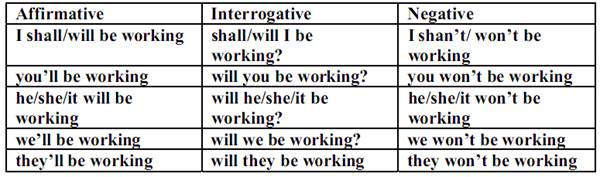
Formation: It is an analytical form which is built up by means of the auxiliary verb to be in the simple future and participle I of the notional verb.